
Who is Yuki onna?
As part of Japanese folklore Yuki onna, or the snow woman appears on snowy winter night to lure hapless travellers. We can see her as a representation of the perils of winter travel. If you are not careful out there bad things could happen to you if you do not respect your surroundings.
Winter can be a dangerous time. With the threat of isolating snow storms and the perils of the cold. Japanese ancient folklore has the Yuki-onna, which translates to ‘snow woman’. She appears on snowy nights as a beautiful woman in a white kimono. Hapless travellers or do-gooding passer-bys can be caught by her helplessness out in the snow, but she is not a lost beautiful woman. Before the 18th century she was always seen as evil, turning those who tried to help her to frozen heaps with her icy breath. But some tales tell of her letting some victims go.
Winter peril from a beautiful woman: Yuki-onna
She is usually described as an enchantingly beautiful woman with long, flowing hair, blue lips and an ethereal appearance and ghostly white skin. She is often depicted wearing a white kimono, which camoflagues her into the snowscape. If you look closely you will see that her kimono closes from right to left, instead of left to right, as only the dead have their kimono fastened right to left. In some stories she is carrying a baby, in others she has no kimono but is naked in the snow. One story says she is the result of a woman and her baby who perished in a snow storm and now forever haunts the icy realm.
The Yuki-onna is associated with winter and snow and preying on travellers out in the mountains. Having the ability to control and manipulate ice and cold, freezing her surroundings with a mere breath. Her lethal kiss can drain the the life force of the hapless traveller, leaving them cold, frozen and lifeless in the snow. In some stories, she is said to leave trails of frost or snowflakes in her wake, so she is often associated with icicles.
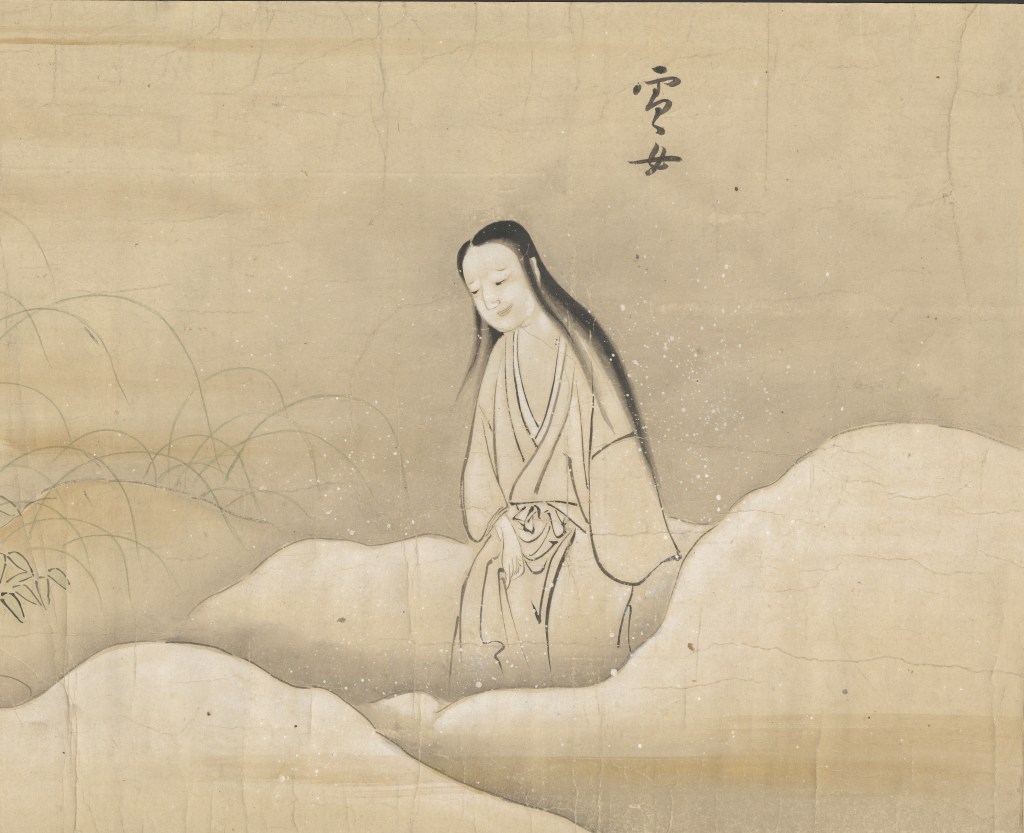
Appearing during snowstorms or on cold, wintry nights, she is often stumbled upon in desolate, mountainous regions or remote areas covered in snow. She if often mentioned floating across the snow and leaving no footprints, with some stories saying that she has no feet. Her piercing eyes can capture those who come across her.
The legends of travellers seduced by the ethereal yuki-onna could have a correlation with some traits of hypothermia. Some hypothermic people begin to feel warm or hot and take off their clothes, further condeming them to the icy grip. This paradoxial undressing seems to be a confusion in the brain where the extreme cold is seen by the brain as extreme heat and the person tries all they can to cool down. Could this be an explanation for the yuki-onna?
Her terrifying reputation does have some softer sides, some stories depict Yuki-onna as a more maternal figure. Sparing the lives of those she comes across as long as they stay well intentioned in life. In these versions, she may spare the lives of children or show mercy to those who demonstrate kindness or humility. There are stories where she has met those she has spared again and again, spares their life.

There are many and various regional variations of the Yuki-onna legend in Japan. In some stories, she is portrayed as a vengeful spirit seeking retribution for a betrayal or injustice, while in others, she is a more mysterious and otherworldly being, not necessarily malicious but still capable of causing harm. In Tottori prefecture she can appear as a beggar, as a seeker of children on Niigata prefecture and in others she engages travellers in conversations before she attacks.
The Yuki-onna legend has been a source of inspiration in Japanese literature, theater, and film. Many works, including short stories, kabuki plays, and contemporary films, have explored and reinterpreted the character of Yuki-onna in different ways.
Yuki-onna are an iconic and enduring figure in Japanese folklore, representing the captivating yet perilous nature of winter and the unforgiving beauty of snow-covered landscapes. In many areas of Japan the snow drifts can become very deep which makes the winter dangerous. It is folklore such as the yuki-onna which are told to keep travellers in the snow wary of their surroundings and to think before they travel.

 Uncanny Lounge
Leave a comment