
The Victorian era, marked by its scientific advancements and a deep fascination with the supernatural, witnessed the rise of spiritualism and a surge in the popularity of ghost stories. As the long nights of winter settled over gaslit parlors, individuals gathered to explore the unknown, seeking entertainment, or a connection with the ethereal.
Victorian Spiritualism
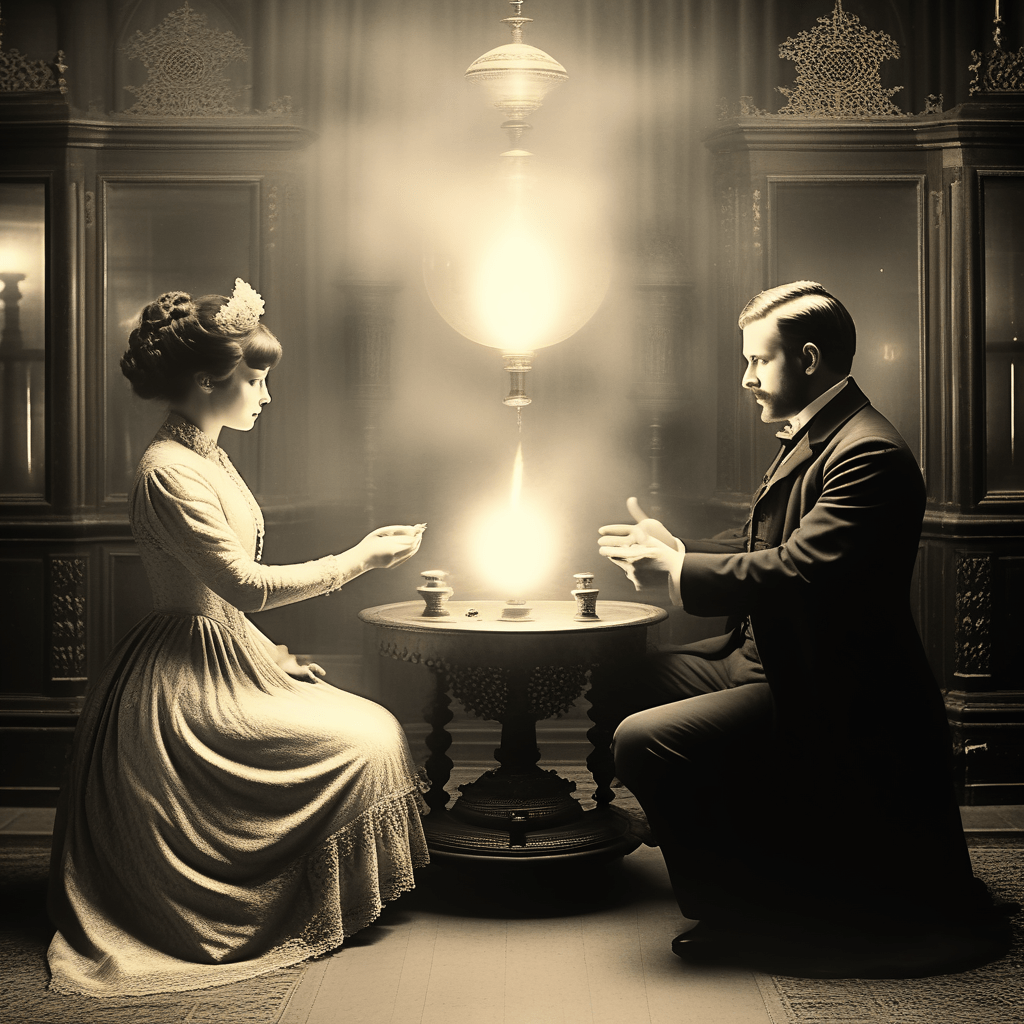
In the midst of societal shifts and scientific progress, Victorians found themselves drawn to the idea that the veil between the living and the dead could be lifted. Seances, conducted in dimly lit rooms with flickering candles, became a fashionable pursuit. Mediums claimed the ability to communicate with the departed, and spiritualist societies provided platforms for believers to share experiences and delve into the mysteries of the afterlife. Societal changes also meant that people were seeking new meaning instead of the puritanical religious teachings they had been following. Early writings from Emmanuel Swedenborg (1668-1772) explored the natural versus the spiritual world. Along with Anton Mesmer (1734-1815) who developed a form of hypnotism around his theory of energy transference. These thinker’s ideas merged with the societal changes and spiritualism became a common obsession for many Victorians in the mid 19th to late century.
We can match the growing interest in spiritualism (other realms) with the industrial progress that was happening at the time, and for the Victorians these advancements must have seemed other worldly. It must have been an interesting period with the spreading use of electricity, telephones, railways, photography. Is it such a small leap to take from cranking a lever and speaking to someone on the telephone to being able to harness another energy and be able to speak to someone who has died and is not there? Spiritualism was also amplified by technological advancements like photography. Early photographic techniques, still in their infancy, led some to believe that spirits could be captured on film, adding a tangible dimension to the pursuit of the supernatural.
Ghostly tales in Victorian Literature

Literature, always a reflection of societal interests, embraced the fascination with the otherworldly. Notable authors such as Charles Dickens and M.R. James wove spectral elements into their narratives, creating enduring ghost stories that continue to captivate readers. Arthur Conan Doyle was a vocal spiritualist. Conan Doyle’s friendship with Harry Houdini was quashed over their disagreements about spiritualism. Houdini then settling on a quest to debunk spiritualism. Continuing after Houdini’s death, his wife Beth held an annual séance to try to get Houdini’s secret code that would let her know he was contacting her from the other side. After 10 years of trying to contact Houdini, Beth finally gave up hope on being able to contact him.
The most recognisable Christmas ghost story is Dickens’ “A Christmas Carol,” a timeless tale of redemption and the consequences of avarice, embodies the spirit of Victorian Christmas ghost stories. The novella, published in 1843, introduced readers to the miserly Ebenezer Scrooge and his transformative encounters with spirits on Christmas Eve. The themes of A Christmas carol could be seen as an allegory of redemption from a Christian perspective or a more secular reading as a moral philosophy on charity and altruism. Dickens was said to have been appalled at the working conditions of industrial child workers and was vocal on his concerns about poverty and injustice.
M.R. James, a master of the ghost story genre, contributed chilling tales that often explored academic settings and ancient relics. His stories, including “Oh, Whistle, and I’ll Come to You, My Lad” and “A Warning to the Curious,” 1925, delved into the psychological and supernatural, leaving readers with a lingering sense of unease. “A warning to the curious” brings a satisfying mounting sense of dread of being watched and followed after disturbing buried artifacts with rising and falling in intensity before it reaches its morbid conclusion.
If we compare M.R.James with the prior horror literature such as “Dracula”, Bram Stoker 1897, “Frankenstein”, Mary Shelley 1818 we can see M.R. James building in modern (for their time) themes which still gives them a contemporary feel, aside from the syntax of the language used. As a medievalist, M.R. James winds this subject into his works with many in the context of heard stories. Interestingly for the contemporary feel of James’s ghost stories he was said to be a critic of other contemporary authors such as Aldous Huxley, perhaps their themes were too far into the future as his still looked to the past.
Christmas Eve and the tradition of ghostly tales

The tradition of telling ghost stories during the Christmas season became a cultural phenomenon. The long, dark nights of winter provided an atmospheric backdrop for tales that blended the festive with the eerie. Families gathered by the fireside, sharing stories that resonated with both the warmth of the season and the chill of the unknown.
With the Industrial Revolution many oral traditions such as story telling were able to be spread to a wider audience with the help of the steam powered printing press. With this the commercialisation of stories began their rise, with many authors being pressured to pump out their stories in time for Christmas sales. We can understand much of the interest in spooky stories when we understand that the rise of scientific discoveries, religious questioning, increasing changes from industrialisation and the shift from rural to urban living all would have made the Victorians a little uneasy and escaping into the confines of spooky stories could have given them an escape from their uncertain present. If we add to this the threat of childhood mortality and the threat of disease we can understand that morbid thoughts may not have been far from the Victorian mind.
Increasing literacy in the population and the availability of material from the inexpensive to premium coffee table books, there was something for every class of Victorian England. Charles Dicken’s may be mostly known for ‘A Christmas Carol’ (1843) but he also wrote other Christmas stories which also included ghosts. The themes of Dicken’s resonate with what we now think of Christmas, with reunions, forgiveness and family gatherings. MR James would invite a select few for a Christmas Eve gathering to hear a few of his creepy tales. If you would like to try a few more authors from that time you can search out, Arthur Conan Doyle, Wilkie Collins, Nathaniel Hawthorne, Elizabeth Gaskill and Margaret Oliphant.
Victorian spiritualism and ghost stories were intertwined expressions of a society grappling with the uncertainties of the era. From the dimly lit seance rooms to the pages of classic literature, the Victorians sought to understand the mysteries beyond the tangible, weaving a tapestry of tales that continue to captivate and haunt the imagination. If you are looking for a new Christmas tradition perhaps you could look back to traditions of old and gather the family for a relaxing séances or calm your nerves with a few tales of dragging chains and creaking boards in the dark.

 Uncanny Lounge
Leave a comment