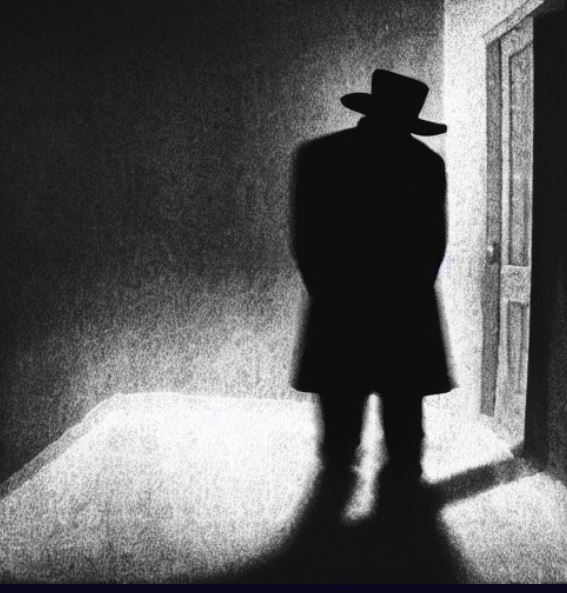
Have you ever woken in the dead of night, frozen in your bed, aware of something watching you from the corner of the room? Have you ever felt a chilling presence in the dead of night, a shadowy figure lurking at the edge of your awareness? Maybe you caught the outline of a tall, dark figure, a man in a wide-brimmed hat, silently observing you from the shadows.
If so, you’re not alone. You may have met the Hat Man, one of the most chilling entities reported in cases of sleep paralysis around the world. This eerie specter, clad in a dark coat and distinctive hat, has woven himself into the fabric of sleep paralysis lore, haunting the dreams and waking moments of people worldwide.
The ancient origins of sleep paralysis
Sleep paralysis has haunted humans for centuries. Its roots trace back to as early as 1664, when a Dutch physician documented it as the “Incubus or the Night-Mare” afflicting one of his patients.
Before science offered explanations, people turned to myth. Different cultures have woven their own narratives around sleep paralysis. Egyptians blamed jinn, supernatural beings who could sit upon a sleeper’s chest. In South Africa, the Tokoloshe, a mischievous water spirit, was said to be the cause. Across Europe, tales of demons and witches “riding” their victims filled the night air. These terrifying interpretations persisted well into the 20th century, until scientists began peeling back the mystery.
The Science Behind Sleep Paralysis
Today, we know that sleep paralysis occurs during the transition between REM (rapid eye movement) sleep and wakefulness.
During REM, the body naturally paralyzes itself to keep us from acting out our dreams. But sometimes, the brain wakes up before the body does. The result? You’re conscious, but unable to move or speak.
And in that suspended state, half dreaming, half awake, the mind can conjure up incredibly vivid hallucinations. Hallucinations often accompany sleep paralysis, manifesting as vivid and sometimes menacing figures. For many, those visions take the form of dark shapes, shadowy intruders… or one figure in particular. Enter the Hat Man, a recurring character in these nocturnal dramas.
Meet the hat man: A global phenomenon
Unlike most dream figures, the Hat Man appears across cultures, languages, and continents. He’s almost always described the same way:
- Tall and dark, sometimes featureless
- Wearing a wide-brimmed hat or fedora
- Often cloaked in a long coat or trench
- Standing silently, watching
Some say he has glowing red eyes. Others describe him as a shadow darker than the surrounding night. Yet his behavior is strangely consistent: he rarely attacks, rarely moves, he simply observes. That eerie stillness may be what makes him so unnerving. He feels aware.
What sets the Hat Man apart is his ubiquity across different cultures. Unlike localized sleep paralysis monsters, the Hat Man appears in bedrooms worldwide, his description varying only slightly from one account to another. Some describe him as tall, with bright red eyes, while others perceive him as a misty presence with a penchant for wearing a trench coat and a hat. Interestingly, the Hat Man’s behavior is distinct from other sleep paralysis entities. He doesn’t engage in physical contact or aggression but rather observes silently from corners or hovers over beds, casting an aura of malevolence without overtly threatening actions.
Theories: From Shadow People to Psychology
The Hat Man is often linked to the phenomenon of Shadow People, dark humanoid forms reported by countless witnesses. Some paranormal researchers suggest these entities may be interdimensional beings, spirits, or even extraterrestrial visitors. The hat and coat, they speculate, might be a disguise—an attempt to appear “human” to those who see him.
The Hat Man when grouped with shadow people, dark humanoid figures they are believed by some ufologists to be extraterrestrial visitors. Paranormal experts speculate that the Hat Man might wear hats and coats to conceal imperfect features, adding an intriguing layer to his mystique.
Skeptics, however, lean on neuroscience. To them, the Hat Man is a projection of the subconscious, a nightmare that bleeds into waking reality.
For those experiencing sleep paralysis, the boundary between dream and reality blurs, creating an environment where nightmares can manifest with unsettling realism. When you can’t move and feel vulnerable, the mind gives shape to your fear—and the shape it often chooses is human.
What does Hat man want?
Those who’ve encountered the Hat Man often describe an overwhelming sense of dread. Yet, unlike other sleep paralysis entities, he doesn’t touch, attack, or speak. He seems to feed on fear itself, lingering as if drawing power from your terror.
While encounters with the Hat Man are fraught with fear and unease, he seldom crosses into physical harm. Instead, he seems to feed on the psychological terror of his victims, leaving them paralyzed with fear and dread. His presence, whether a product of astral projection or vivid nightmares, leaves a lasting impact on those who encounter him.
In the realm of supernatural lore, the Hat Man remains a mystery, a spectral observer that hunats the liminal spaces between sleep and wakefulness. Whether a creation of the subconscious mind or a manifestation of deeper fears, his presence in the world of sleep paralysis adds a layer of intrigue to the mysteries of the night.
Whatever he is, one thing is certain: people who’ve seen him never forget him.
A symbol of the night’s deepest mysteries
As the internet amplifies personal experiences, the legend of the Hat Man continues to grow. He stands at the crossroads of science and the supernatural, as a living metaphor for the blurry line between dreams and reality.
As people become fascinated by the paranormal, his legend grows. Whether viewed through a scientific lens or as a harbinger of the unknown, the Hat Man represents a an intrigue with the boundaries between dreams and reality, fear and fascination, darkness and light.
Whether he’s a trick of the mind or something far older and stranger, the Hat Man continues because he touches something primal: our fear of being watched, our vulnerability in sleep and our fascination with the dark.
Final thoughts
The next time you find yourself hovering between waking and dreaming, and you sense a presence in the room. Don’t be too quick to dismiss it.
That shadow with the hat at the edge of your vision?
It might just be him, the Hat Man, the silent sentinel of the night.

 Uncanny Lounge
Leave a comment