
Tiny. Quick. Almost invisible until you hear that confident burst of song.
The wren is one of nature’s smallest birds, and yet, for centuries, it’s been called “The King of Birds.”
How did such a humble creature earn a royal title usually reserved for eagles, hawks, or ravens?
The answer lies in a story older than recorded history, and in the remarkable behavior of the wren itself.
In this post, we’ll explore the myth, the folklore, and the science behind the wren’s royal reputation, and why this tiny bird continues to capture human imagination.

The ancient contest: How the Wren became King of the Birds
Long before written myths, people told stories to explain why the world was the way it was. One of the most beloved bird legends appears across Europe and the British Isles, and its variations all point to one small truth: cleverness can triumph over size.
The Challenge of the Birds
According to Celtic and European folklore, all the birds once gathered to decide who should be their king.
To settle the matter fairly, they agreed:
“He who can fly the highest shall be our ruler.”
The mighty eagle, confident in his broad wings and unmatched strength, took off with powerful beats, soaring higher and higher. The smaller birds dropped out one by one until only the eagle remained, climbing toward the sun itself.
When the great bird could go no farther, exhausted but triumphant, a faint rustle came from his feathers.
Out popped a tiny wren, who had hidden beneath the eagle’s wing.
With a cheerful chirp, the wren took flight, soaring just a few feet higher than the eagle and called down,
“Behold your king!”
The other birds were astonished.
Though the eagle had done the heavy lifting, the wren’s cleverness had outmatched his power.
And from that day forward, the wren was known as The King of Birds.
A Trickster’s triumph: The folklore’s hidden meaning
At first glance, this is just a fable about a smart little bird outwitting the big ones. But under its feathers lies a deeper truth, one that ties into human psychology, mythology, and seasonal cycles.
Intelligence Over Might
The story celebrates wit over brute force.
In ancient cultures, the wren represented cleverness, cunning, and adaptability, traits that were essential for survival.
To early humans watching the natural world, the wren’s ability to dart through thickets, sing loudly despite its size, and survive harsh winters made it a perfect symbol of intelligence and perseverance.
The Cycle of death and rebirth
In Celtic tradition, the wren was often hunted on St. Stephen’s Day (December 26th) during “The Wren Hunt.”
Men would go from house to house, carrying a wren effigy on a stick and singing:
“The wren, the wren, the king of all birds,
On St. Stephen’s Day was caught in the furze…”
Though grim by modern standards, the ritual had symbolic meaning:
the death of the old year (the wren) gave way to the birth of the new (the robin or eagle).
In essence, the wren was both the end and the beginning, a creature that marked the turning of the year.
The “King of Birds” story may also reflect this cycle: the wren rises (as king) when the sun is low, ruling the darkest days of winter, before yielding to brighter birds of spring.
The Wren in Celtic and European lore
The legend of the wren isn’t confined to one land.
It appears across Ireland, Scotland, Wales, France, and even in Norse tales, always with similar meaning: small, bold, and wise beyond measure.
In Irish Folklore
The Irish name for the wren, “Dreoilín,” translates to “little druid.”
This connection to the druids suggests the bird was seen as magically gifted, capable of divining secrets or whispering prophecies.
It’s said the druids once watched the flight of birds to read omens. Because the wren flew swiftly and unpredictably, it was associated with divine messages and hidden knowledge.
In British Custom
In England, the wren was a symbol of royalty disguised in humility, the idea that greatness can hide in the smallest form.
Even Shakespeare alluded to this in Macbeth:
“The poor wren, the most diminutive of birds, will fight,
Her young ones in her nest, against the owl.”
Here, the wren stands for courage and fierce protection, a queen defending her realm.
In France and the Isle of Man
The French called it “roi des oiseaux”, literally “king of birds.”
On the Isle of Man, traditions say the wren was once a woman transformed, a siren or fairy queen who deceived and escaped her pursuers by turning into a wren.
Her yearly “hunt” symbolized the containment of chaotic feminine power, another layer of the bird’s mythic authority.
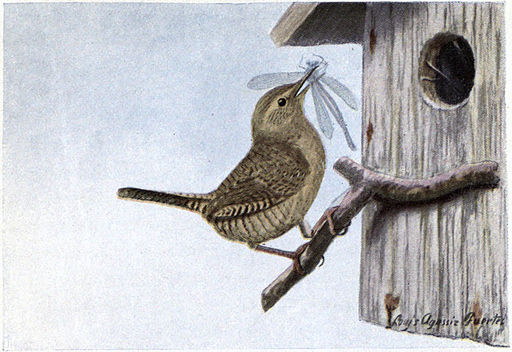
The science behind the story: Nature reflecting myth
Myth alone can’t make a creature a king, but nature often gives myth a reason to exist.
And the wren’s behavior explains why ancient observers were so fascinated by it.
The Loudest Song for Its Size
Wrens are tiny, around 10 cm long, yet their song is one of the loudest in proportion to body size.
They sing around 90 decibels, roughly the volume of a lawn mower, to mark territory or attract mates.
That’s equivalent to a human shouting across a football field, a small creature projecting authority far beyond its size.
It’s not hard to see why ancient people might have heard that commanding song and thought:
“This little one must be a king.”
Bold and Curious Behavior
Wrens are fearless. They hop into open barns, explore human homes, and defend their nests fiercely.
Despite their size, they’ll challenge much larger birds, embodying that Shakespearean courage.
Their adaptability allows them to survive in a wide range of habitats, from tangled hedgerows to urban gardens, making them one of the most widespread birds in the Northern Hemisphere.
This resilience mirrors the trickster energy found in their myths.
A Solar Connection
In nature, wrens are particularly active at dawn, their song is often among the first heard at sunrise.
In folklore, this connects them to rebirth, renewal, and the returning light, another reason they may have been crowned king during the darkest time of year.
The dual nature of the Wren: Humility and power
The wren’s mythic title of “king” isn’t just irony, it’s a lesson.
In most folklore, the smallest creature who uses wisdom over strength becomes a sacred archetype: the mouse that steals fire, the trickster who outwits gods, the hero who triumphs with cunning.
The wren stands for:
- Wisdom hidden in smallness
- Voice as power (its song as declaration)
- Adaptability and intelligence
- Renewal through trickery or transformation
This blend of light and shadow, humility and confidence, makes the wren deeply symbolic, a kind of natural koan reminding us that size and status mean little next to ingenuity.
The Wren Hunt: Death of the Year King
One of the most long lasting and haunting customs tied to the wren is the Wren Hunt of Ireland and the Isle of Man.
Historically, groups of men called “Wren Boys” would go door to door on St. Stephen’s Day, carrying a wren (real or symbolic) in a decorated bush, singing songs and collecting offerings.
While it sounds macabre today, it was once a form of ritual renewal:
- The wren represented the old year, the dying sun.
- The hunt symbolized the death of darkness and the rebirth of light.
- The following day, festivities honored the return of the sun, the new king.
This aligns beautifully with the solstice cycle:
the wren rules when the sun is weakest, then passes the crown to the robin, the bird of dawn and spring.
Thus, the “King of Birds” is not just a title of victor, it’s a role in the great wheel of time.

What the Wren can teach us today
Even in the modern world, the wren carries timeless lessons.
- Don’t underestimate yourself.
Great power can exist in small, quiet packages.
The wren reminds us that strategy often outshines strength. - Sing your truth loudly.
Its song cuts through the noise of the world. A symbol of authentic voice and communication. - Adapt and thrive.
The wren builds its nest in unexpected places, even in pockets of human life, showing us how flexibility leads to survival. - Honor the cycles.
The wren’s mythology ties it to winter solstice, death, and rebirth. It teaches that endings are beginnings in disguise.
The King of birds: A crown earned and not given
Whether you view the legend as folklore, allegory, or ancient wisdom, the message is clear:
the wren’s kingship is not about domination, it’s about cleverness, courage, and song.
The eagle may soar higher, but the wren reminds us that true greatness often hides in the smallest forms.
It’s not the size of the wings that matters, it’s the power of the spirit that drives them.
So next time you hear that bright, bubbling song from a hedgerow, pause and remember:
you’re hearing the voice of the King of Birds, tiny, wise, and eternally bold.

 Uncanny Lounge